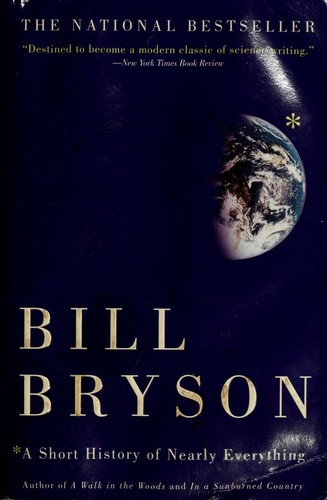
ISBN: 076790818X
Publisher: Independent
Year: Unlisted
Length: 544 Pages
A Short History of Nearly Everything
Synopsis & Analytical Review Framework
In the contemporary literary landscape, few works manage to achieve both structural integrity and deep thematic resonance. A Short History of Nearly Everything, curated under the analytical vision of Bill Bryson, emerges as a compelling masterclass in its field, currently commanding an impressive community score of 4.19. For readers navigating the saturated paths of , this print matrix represents a definitive structural milestone that demands serious critical evaluation.
In Bryson's biggest book, he confronts his greatest challenge: to understand--and, if possible, answer--the oldest, biggest questions we have posed about the universe and ourselves. Taking as territory everything from the Big Bang to the rise of civilization, Bryson seeks to understand how we got from there being nothing at all to there being us. To that end, he has attached himself to a host of the world's most advanced (and often obsessed) archaeologists, anthropologists, and mathematicians, travelling to their offices, laboratories, and field camps. He has read (or tried to read) their books, pestered them with questions, apprenticed himself to their powerful minds. A Short History of Nearly Everythingis the record of this quest, and it is a sometimes profound, sometimes funny, and always supremely clear and entertaining adventure in the realms of human knowledge, as only Bill Bryson can render it. Science has never been more involving or entertaining.
Ultimately, the broader cultural and intellectual impact of A Short History of Nearly Everything lies in its ability to foster continued dialogue long after the final page is turned. Bill Bryson has successfully assembled a distinct print architecture that elevates the current standards of writing. For those seeking an immersive intellectual framework, this volume remains a highly recommended discovery.
Reader Critical Response Manifest
A fascinating history of science. Ever curious how everything we know about the world came to be - read this! I loved reading about what old greats like Darwin thought about the world - they were all right about most things, but also very wrong about some things - makes you wonder how much we are wrong about today! Another interesting piece was how many of the world's prominent scientists had the time to do their research because they came from rich families. Very different from todays notion of 'trust funders'.
Here's the deal. This star rating is probably mostly my own fault. Bryson is an amazing writer, and I really enjoy reading his travels. I was under the impression that this would be a summary of world history, not the planet's history. Since I am a believer of intelligent design, I was doubly disappointed.
Although I only gave this book two stars, I think it will earn more as time goes by. It's length and depth makes it an intimidating text to finish. In fact, most people who recommended this book to me hadn't finished it! I did, so tra-la-la. I think I'll enjoy it even more in the future, when I have a question about mitochondria, for instance. I'll just pull out my handy Bill Bryson guide and re-read that chapter. Although at times the science history is a bit too detailed, in general Bryson's work is accessible and fun to read.
wow, I closed this book feeling like I 'knew' about astronomy, chemistry, paleontology, physics etc. It just took me trying to explain it to one person though for the illusion to crumble. The wonderful thing about Bill Bryson is that he writes in such a way that you feel part of his narrative and that you actually understand him. This was an entertaining and educational read for someone is little to no scientific education at all.
Very good read. A bit dense, but very informative!
I already love Bryson's travel books and now I love his science writing too. His massive history is witty and accessible, if daunting to read from cover-to-cover. To be clear: a "history of everything" means the history of scientific discovery, from what we know of the universe's beginning to humankind's appearance on Earth. It's a lot to tackle, but a fun introduction to the scientific world. This should be required reading in every high school.
I loved this book. Bill Bryson is hilarious. However I know I will need to listen to it again, as there were sections where my thoughts took me elsewhere and I missed important points (the trouble with audiobooks). There were parts that were more interesting than others, as is true of any book of this kind (and magnitude), but overall I learned many important things. I will give you 10, in no particular order: 1. Scientists discovered phosphor accidently while they were attempting to turn urine into gold. They seemed to believe that the similarities in color also indicated a similarity in elemental nature. 2. Genius and absurdity often go hand in hand (read: Sir Isaac Newton, and the scientists mentioned above). Also, this: "In France, a chemist named Pilatre de Rozier tested the flammability of hydrogen by gulping a mouthful and blowing across an open flame, proving at a stroke that hydrogen is indeed explosively combustible and that eyebrows are not necessarily a permanent feature of one's face." 3. Yellowstone is the largest active volcano in the world. Historically it has blown up every 600,000 years or so. The last time was about 600,000 years ago. Since Yellowstone already exhibits all of the warning signs typically seen before a blast, it will take us unawares, and it will be a blast the like of which we have never before experienced in human history. So...that's nice. 4. If you take apart the cells of a sponge by putting it through a sieve, the cells will find each other and rearrange themselves back into a sponge. 5. There is a type of life that normally exists as a single celled organism, but when times get hard they coalesce into a complex organism that resembles a slug. 6. We know very little about the inside of the planet we live on: if the Earth were an apple, we have not yet succeeded in penetrating below the skin. 7. Humans, especially in the last hundred years or so, have exterminated hundreds of thousands of species of plants, insects, and animals. This list includes the Tasmanian tiger, a marsupial carnivore whose last living member died in a zoo due to neglect. 8. If the entire history of the planet were compressed into a 24 hour day, humans would not arrive on the scene until 11:59pm. 9. The statement "all life is one" is, scientifically, one of the truest statements one can make. Every atom that comprises our being has been around forever, as atoms do not die. In fact they do such a good job dispersing and rearranging themselves (and there are so very many of them) that each one of us possesses atoms that once belonged to trees, plants, animals, insects, even historical figures like Genghis Khan and William Shakespeare. Buddhists. They knew what they were talking about. 10. Life is miraculous. There had to be series of events so fortuitous and unlikely to bring us here that it is hard to imagine that it was not guided by a divine hand: "Consider the fact that for 3.8 billion years, a period of time older than the Earth's mountains and rivers and oceans, every one of your forebears on both sides has been attractive enough to find a mate, healthy enough to reproduce, and sufficiently blessed by fate and circumstances to live long enough to do so. Not one of your pertinent ancestors was squashed, devoured, drowned, starved, stranded, stuck fast, untimely wounded, or otherwise deflected from its life's quest of delivering a tiny charge of genetic material to the right partner at the right moment in order to perpetuate the only possible sequence of hereditary combinations that could result -- eventually, astoundingly, and all too briefly -- in you." Finally, one more quote, because I thought it was funny (even if it is also sad because I love aliens): "We may be only one of millions of advanced civilizations. Unfortunately, space being spacious, the average distance between any two of these civilizations is reckoned to be at least two hundred light-years, which is a great deal more than merely saying it makes it sound. It means for a start that even if these beings know we are here and are somehow able to see us in their telescopes, they're watching light that left Earth two hundred years ago. So, they're not seeing you and me. They're watching the French Revolution and Thomas Jefferson and people in silk stockings and powdered wigs--people who don't know what an atom is, or a gene, and who make their electricity by rubbing a rod of amber with a piece of fur and think that's quite a trick. Any message we receive from them is likely to begin "Dear Sire," and congratulate us on the handsomness of our horses and our mastery of whale oil. Two hundred light-years is a distance so far beyond us as to be, well, just beyond us."
An informative and often amusing overview of the history of science. Not only does Bryson detail the history of scientific fact and the discovery process, he also examines the curious quirks that reveal many scientists not as dry, boring men but people with some rather strange tendencies that definitely humanizes them. Overall, a great an educational read. In passing, although many of the technical details were explained, a high school science education would go a long way toward making the book more easily understandable. Although things such as isotopes are explained, for instance, only a brief overview of Mendelson's pea plant genetics was provided.
An entertaining summary of so much interesting science and science history. This is one of those books you could re-read every few years and still find interesting;
I happen to have the illustrated addition which I would think make it look like a textbook. But, I have to say, I'm not one to be a science geek and this is one of the most informational and interesting books I have ever read. The history is really the history of scientific exploration and discovery, and the history of the planet. So it's not the type of history you learn in high school with names and dates. Well, I was a history major, and I never learned any of of information contained in the book, except for maybe the Isaac Newton part. You're probably thinking, yawn, what could possibly make this subject material interesting? Well, Bill Bryson is a brilliant and funny travel writer. He makes the information much more appealing to the general masses. It's not a science textbook that is convaluted with a bunch of science jargon. It all makes perfect sense! And it's kind of funny sometimes, too! And you're probably also thinking, why would a travel writer write a book about the history of the world? Bryson has other interests other than making observations about places and people in places around the world. I'm sure everyone has more than one interest. Bryson describes in his introduction that he's always been interested in this subject material and always wanted to write a book about it. Plus, he's had lots of help from the science community. He's translating the science jargon into human langauge! Another observation I made after reading this was that there are tons of people out there that have made discoveries and someone else has gotten credit for it. Now that just stinks. There were several instances touched on in this book about people who discovered something, no one believed them, someone else discovered the same thing and was considered a genius. Okay, so I'm being a little exaggerative, but you get my meaning. Apparently you can't get the illustrated version anywhere, but I recommend it if you can find it. It has a cool picture of a eye lashes magnified two hundred times to show the eyelash mites that live in your hair follicles. EEWWW!
Correlated Literary Frameworks
No correlated reference modules mapped for this specific print matrix index.